Saturday, April 16, 2011


Victory Ship


I knew Asa Watkins as an old man. During World War II he had claimed Conscientious Objector (CO) status and, through his conscription, gotten the chance to work as a hospital attendant at a mental institution. The many CO's working in such settings found themselves up against deplorable conditions, such as neglect and abuse of the mental patients. They did not accept these conditions, and began many investigations of hospitals around the nation. The result was a fundamental improvement of conditions and an increase in awareness leading to the mental health system we have today. The following story tells what happened to Asa Watkins immediately after his work in the hospital.


ODYSSEY


Whereas most US Service men were released from duty shortly after the US victory in the war (May 8, 1945, for the European conflict and Aug. 15, 1945, for the Japanese conflict), the first mention in Asa’s surviving letters of the release of fellow COs is in his January 7, 1946 letter: “Six men were released today including Jack!” Asa recalled, with some annoyance, that it took until the Spring of 1946 (probably April) for his own release from hospital duty to come through. He saw this as further punishment meted out by the government to COs for their beliefs. Many COs around the nation shared this resentment.

But the point of his release from Eastern State Hospital was not quite the end of the war for Asa. He, like many former CPS'ers, joined relief efforts (specifically, a cattle drive) overseas for humanitarian reasons and out of a curiosity to see what the war had been for others. This would bring Asa to catharsis. Even the most furtive glances about the port cities he visited moved him deeply.

The relief efforts were mounted by the United Nations' Relief and Rehabilitation Administration (UNRRA) with the aim of alleviating the suffering in the war-devastated countries. The cattle drives were conveyed by Victory Ship. The Victory Ship was the style of cargo ship in which all of the post war relief efforts were carried out. It was the more dependable design of cargo ship to succeed the Liberty Ship from earlier in the war. German submarines had sunk those quite frequently and easily. The introduction of the Victory Ship made the war effort, as well as relief, much more successful.

Warren Sawyer was a young Quaker who also happened to serve at Buck Creek, Asa’s CPS work camp at Marion, North Carolina, though they may not have served there concurrently; Asa never mentioned him and may not have known him. From Buck Creek Warren went to work as an attendant at the Philadelphia State Hospital, or Byberry. At the end of his hospital service he also planned to go on a cattle drive by ship. Warren’s and Asa’s voyages may have occurred at different times to different destinations. However, in his letter of Jan 21, 1946,

Warren conveys some basic practical information on the arrangements for a trip that sounds very similar to Asa’s:


“...I expect to apply for a cattle-boat project sponsored by the Brethren Service Committee. They are recruiting ex-CPS men to assist in transporting cattle and horses to Poland. The fellows are needed to care for the animals while they are on the high seas. Each trip lasts about six weeks, and those who participate in the program receive $150 for their services....”

So, presumably, Asa’s relief voyage took about six weeks, and he got $150 for it. This adds to our concrete understanding of it. Asa did not provide accounts of many of the day-to-day things he did as a cowhand. Maybe he would have remembered these better if so many dramatic things hadn’t happened on his voyage.

Richard (“Dick”) Gessell, Jack Gessell’s younger brother, listened attentively as Asa told him about his relief voyage during a visit to him and Jack at their home in Audubon, New Jersey, in June of 1946. Dick had already developed an admiration for Asa since he had met him the year before while visiting Jack at the Eastern State Hospital. Dick was only fifteen at the time, and Asa had impressed him with his great cordiality, having spent some time giving him “the grand tour” of the hospital. Asa had allowed the young man to attend an electric shock treatment and an autopsy, which he found traumatic, but highly interesting. Dick Gessell writes:


I had completed my junior year in high school and was trying, and failing, to find a summer job in the area. Asa suggested I go to Newport News, VA, with the hope of working on a cattle boat. After a short delay, I was in fact accepted and made the voyage to Greece with no difficulties. As with Asa, my ship was chartered by the UNRRA and the cattle were provided under a program sponsored by the Bretheren [sic] Church.


Asa’s tendency to downplay the negative accounts for Dick not having gotten the full picture of the possible perils he he might face at sea. If he had, Dick might have developed a strong reluctance about it. It’s likely that Asa’s account focused on the great need in Europe. Dick would see Asa very few times later in life, but he always remembered him fondly, and admiringly, for his influence in getting him to make his own voyage, an experience he considered useful to others and uniquely educational.

Dick’s account of his own voyage did include his “mundane” duties, which were probably very much like Asa’s: Each cattleman was responsible for a certain number of cows. The chief task was to give them enough grain feed, hay and water from early morning till the evening. It was very hot in the hold, and it oppressed the poor cows terribly. In that heat, water was very important. Cows are more delicate than people realize. They suffered a very high fatality rate due to the toll of the heat and intestinal problems. There was one vet per trip and he was constantly busy looking after all his charges.

Dick remembered the cleanup of the ship after delivery as a most nauseating task. A “horrible stench” remained after the cattle’s departure. The stalls that had been put in especially to hold the cattle would be removed so that the ships’ cargo space could be used for other purposes. If the ships were to be usable for anything else, they needed a good cleaning. To accomplish this, the cowhands flooded the lower sections of the ship with water and scrubbed their hearts out. They spilled a deluge of sweat at that task, carrying out this labor of Hercules entirely on their own. The sailors on board didn’t get involved with clean-up: cattlemen didn’t sail the ship; they didn’t clean up after the cattle.

Once Dick’s trip had been accomplished, he had nothing to do. The Greeks (or the Poles, or the Italians) had nothing to send back to The States, and the ships went back empty. So, on the way back there was lots of free time: time to read, to play games, laze about, or write the detailed journals Dick kept throughout the voyage. Asa, on his return voyage, could have made drawings on the ship, as he had previously made them in the hospital. But if he did, he never mentioned them, and none survive.

Asa arrived at Newport News, VA, with little knowledge of cattle, but ready to shovel manure in order to help those overseas. His Victory Ship left in the spring of 1946 for the European ports of Danzig (now Gdansk), Poland, and Trieste, Italy. A hundred head of cattle were in his care. All the cows were pregnant, and, therefore, twice their number were expected to arrive at the destination. This was not to be, for many of the cows, and their offspring, failed to survive the battering of stormy seas, or succumbed to disease.

The root of many of the problems the ship and crew encountered was the Captain’s addiction to alcohol. He simply couldn’t control the ship. The 1st and 2nd mates, whom Asa got to know well, handled it entirely by themselves. At one point, the ship encountered a terrible storm, almost capsizing. Then, one of the cattlemen, a kid in his late teens or early twenty’s, became very sea sick, as did all the former CPS’ers. But the kid was a diabetic, and needed serious attention. The Captain, perhaps having heard that he had been a hospital attendant, appointed Asa his day nurse, and another cattleman his night nurse. Asa and the other man did the best they could, but the diabetes was out of control. They lacked the proper nourishment to care for him. He went into a diabetic coma and died. Though the Captain was in no state to handle very much, he, at least, had the sense to hold a funeral. He asked Asa to choose bible verses for the service. Asa did so. The Captain was sober long enough to read them. Then, they promptly dumped the boy’s body into the thrashing, boiling ocean. Not long afterward, the ship got lost in a minefield. They managed to sail out of it unharmed. Later, the Captain effected some careless navigation, and got them stuck on a sandbar.

When the ship finally docked in Poland, the surviving cattle were unloaded. Then the Captain had a “gorgeous dame” hauled up to the bridge in a lifeboat. She remained encapsulated in his cabin for the entire time the ship was docked in Gdansk. Just before embarking on the voyage back to the US, the lifeboat descended with the “beautiful creature,” who climbed out onto the dock and disappeared. The Captain then refused to take the ship to Copenhagen to take on water as ballast. That was a very serious failure. If, for instance, the ship had run into another storm in the Atlantic it could easily have capsized.


Finally done with the war, Asa moved to New York City in the fall of 1946. There he embarked on a fully civilian life. There he resumed his involvement with art at the New York Studio School. Eventually, he settled in Morristown, New Jersey, and went on to teach art at Rutgers University in the early 1950s. Perhaps as a carry over from his experiences as a hospital attendant, he offered art therapy in the Newark School system to emotionally disturbed and physically handicaped youngsters, from 1956 to his retirement in 1983.

Friday, March 11, 2011

Improvization #1


Improvization # 1

By
Manuel Macarrulla, 2011
Scratch Board
8" X 10"


Just don't ask me what my message is.

Monday, May 31, 2010

Religious Murals


Our Lady of Grace

Patron Saint of the Dominican Republic

Elton Street, at Fulton

East New York


Here, again, is a sign of what I've said before about the ubiquity of Dominican symbols in the neighborhood of East New York. Above, La Virgen de Alta Gracia, a uniquely Dominican presence, lends her weight to the character of the neighborhood. Rendered, evidently, by an unschooled painter, the figure, nevertheless, reaches any Dominican viewer with instant messages of a familiar culture, and old memories of home.


Jesus
Elton Street, at Fulton
East New York


Sunday, May 23, 2010

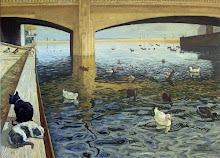
Dog in the Water


Dog in the Water
Oil pastel
10 1/4" X 9"


Here's an image I just made as a birthday present to my daughter. It was fun to do, since oil pastel seems to have become a favorite medium of mine over recent years. I also like to find this sort of country-like subject right in my city, one of the largest in the world. Right in the middle of that there's Prospect Park, where the bucolic finds expression. I prefer to contemplate the pleasant things in life.

Saturday, May 15, 2010

Butch.

My sister, Dulce Macarrulla, wrote a book of stories recounting her recollections from her many trips to far away places (published by the Banco Central de la República Dominicana, 2001.) Sadly, we lost her to liver cancer in August of 2008. Below is my translation of one selection from her book.


Butch

By Dulce Macarrulla. Translation by Manuel Macarrulla.


Butch was the most unpleasant dog I had ever known.

He had a face just like his owner’s: wrinkled, ugly, and with a killer’s aura. He was the compound’s lord and master and no one dared cross him for fear not only of what he would do, but his owner’s reaction. The latter was the company director, and he acted (at least in this respect) just like his dog. He gave strict orders that no one may own chickens or cats, since they would certainly be destroyed by the hostile boxer. We were all very careful about both the dog and the master.

A friend gave our children an adorable little white dog with honey colored spots, whom they called Spotty, and who brought them much joy. He shared their excursions and adventures. He was sweet and kind. But Spotty now had to remain indoors constantly for fear of a run in with Butch, who had fallen in love with our terrace, and on which he would spend long hours taking some air, huffing, and fulfilling his role as lord and master of all.

The name “Butch” was derived from the English word “butcher.” I’d never seen a more suitable name. He was huge and ornery. We were so afraid of him! When he got near the terrace we would all leave whatever we were doing and we’d scurry into the house, same as Spotty, with our tails between our legs. But one day he surprised us and before we realized it he was among us. With an agility out of keeping with his corpulence he grabbed Spotty, putting his little head entirely in his huge mouth, and started to shake him from side to side, and I still don’t understand how he didn’t break his neck.

The children’s screams drowned out the little dog’s screams, and those of the maid. They all stayed against the wall letting loose such screeches that they made me grit my teeth. There was, in me, such a rush of adrenalin that without knowing how I went at the huge dog, and, grabbing the choke collar, which his owner had put there wisely, I picked him straight up and kept him aloft who knows how many minutes. The pressure on the neck made him open his huge mouth. Spotty dashed for it, followed by the row of kids, who scurried into the house, where they gave him first aid and all the love he needed. I stayed there, with the huge dog dangling from one had, not knowing what to do or how to do it.

A thousand things went through my mind: “If I hold him up for a long time I’m going to kill him; if I kill him, Henry’s going to lose his job; if I let him go, he’ll grab me and tear me to pieces....” This was my most prominent thought.

How was I able to pick up an animal weighing around 200 lb. with only one hand? You have to take into account my small size. Where did I get the strength? Maybe my children’s terror; maybe the injustice that such a huge dog would mistreat one so sweet and little. To this day I’ve never known exactly how I did it, or why.

“Let him go, ma'am, let him go!” said a distant voice, as in a dream. It was the maid who counseled me from inside the house.

And I did.

I remained rigid. The huge dog fell to the ground in a lump, lying on his side with his four legs straight and stiff. He didn’t move. He didn’t breathe. His open eyes were bloodshot. They seemed fixed on infinity. Inert.

I kept looking at him with spooked eyes, mute, trembling. And suddenly something made me move and I went into the house where I started to make absurd turns about the place. I walked quickly from the dining room to one bedroom, went through the shared bathroom and went out through the other bedroom, while I repeated in a loud and pressured voice, “I didn’t want to kill him; I didn’t want to kill him; I didn’t want to kill him...” In one of those turns I looked toward the dresser mirror and recognized the image of a hysterical woman, which shook me and made me come to.

I ran out to the terrace with the servant, and, from a safe distance, we turned the hose on the dog. With feelings of relief, mixed with fear, we saw him slowly revive and get up to stumble toward his house.

Did his owner ever find out? I don’t know. Did he learn a lesson? I don’t know that either. I only know that Spotty ran like a deranged character when he heard him nearby, even if he was a mile away, and he’d get in the house like a bullet and hide under some piece of furniture.

But I’ll tell you one thing, the terrace belonged to us from that moment on.


Monday, May 10, 2010

East New York: The Light Under the El


How many of you remember Joseph Von Sternberg's films? I do, though I haven't seen one in many years. I vaguely remember that Marlene Dietrich was in those films. To me, the light was the star. Sternberg's light made every earthly setting into some etherial Middle Eastern fantasy.

As I walked under The El, recently, on East New York's Fulton Street, I found myself seeing Joseph Von Sternberg's lighting before my eyes.


Joseph Von Sternberg's Light
Digital Photograph
May, 2010


Dominican Flag
Digital photograph
May, 2010


My compatriots in East New York are very fond of their flag. This one is of a type I'd never seen before; the central shield overlaps the red and blue fields, rather than remain neatly ensconced within the center of the white cross, as in the traditional design.


Fulton Street Under the El
Digital Photograph
May, 2010


Saturday, May 1, 2010

East New York Maniquins

These days I see a lot of East New York, since I work there. I'm getting to know to what extent the area is another Washington Heights, full of Dominicans. You see Dominican symbols and culture to an amazing degree there. And, being an artist who likes to take photographs, I've thought of capturing images from the neighborhood more than once. The other day, something cried out immediately to be photographed. I could no longer hold back. Here it is.


East New York Maniquins I
Digital photograph
April 2010


I took out my camera and began considering my vantage point, the scope of the image, and whether I should stand in the middle of the street to achieve the proper distance from the subject. I snapped the shutter and experienced the bliss of creativity.

Surprisingly, out came the proprietor of the store in front of which this motif was set. She was a Dominican woman speaking fairly good English. She demanded to know whether she could do something for me. Her tone had the sound of an inquiry aimed at protecting her property from some intruder's vandalism.

I began marshalling my excuses and explanations: I'm an artist and sometime photographer, interested only in capturing aesthetically pleasing or interesting images of my environment. I'm not any sort of City inspector, or Immigration official gathering information in order to bust your establishment. If that failed to sway her, I could fall back on my status as her compatriot; her soul mate, of sorts.


East New York Maniquins II
By Manuel Macarrulla
Digital photograph
April 2010


In the nanosecond that I contemplated these options I didn't look at her. I snapped the shutter four times. I waved her off without concern. "Nothing, thanks." I got in my car, and drove away.

Wednesday, March 24, 2010

F - Bomb

I know that now we'll be hearing plenty about Joe Biden's "F-bomb." Let's compare this inadvertently-on-tape "gaff" to another.

Biden: "This is F------ big!"

Reagan: "My fellow Americans, I'm pleased to tell you today that I've just signed legislation that will outlaw Russia forever. We begin bombing in 5 minutes."

Which one has the potential to burry us under many megatons of humor?


Goat Song # 4: Tie a Yellow Ribbon
Manuel Macarrulla, 1991
Oil on linen
96" X 48"

Sunday, March 14, 2010

Self-Portrait, 2007


Self Portrait
Mixed media
11" X 8 1/2"


I made this self portrait as a demonstration piece in 2007, when I was teaching portraiture to a class of 5th graders. I intended to illustrate the use of diagramatical lines in the planning of the drawing. These I made on white paper, in red-brown conte crayon. The descriptive drawing lines are layed in black marker on a clear acetate sheet affixed to the paper.

Thursday, February 25, 2010

Self-Portrait at 18


Self-Portrait at 18
Pencil
12" X 9"


No matter what I learned about drawing later, or, how much I've grown since then, this is still my very favorite self-portrait. I'll probably never beat it for sheer character. It's the perfect record of my adolescent sentiments.


Saturday, January 30, 2010

A Cool Association


Bridge of the 3 Springs (detail)
1906


I was thinking of the aesthetic hideousness I find in 3D movies, mentioned previously, and I recalled seeing small sections of some of those movies without the glasses. I just put my finger on what I liked about seeing those bits: they’re cool. In fact, those fuzzy, floating veils of color remind me of Paul Cezanne watercolors (without the glimpses of white paper), which I consider a high point of aesthetic beauty.

Wednesday, January 13, 2010

Avatar.

When seeing a dance performance, I think sitting up high is ideal, to facilitate a greater appreciation of the depth of the stage. But, when I think of the essence of film, which is a series of images, I dislike the whole notion of 3D. The picture plane is king, for me. I like my pictures flat. This although such realism in dimentionality is vastly impressive. Thankfully, once I started watching Avatar the content took over, and I promptly forgot about the trick. Avatar is very beautiful for the thoroughness of imagination the film makers applied to it. It is full of very evocatively realized vegetation, exotic animal life, and, of course, a moving story, and action.

Monday, January 4, 2010

Two From the Archives

Every now and then I look back over old pictures and ask myself, "Which ones still look good to me." I was doing that, in recent days, and found a number of old friends. Here's a couple of them.


3 nidos (3 Nests)
Manuel Macarrulla, 2006
Oil pastels
9" X 12"


Gato (Cat)
Manuel Macarrulla, 2007
Corlored pencils
9" X 12"


Monday, December 14, 2009

Two Animal Portraits

I offer you two animal portraits done in the last two years. Animals are an endless source of beauty and life, and I love painting them.


Greta
Manuel Macarrulla, 2008
Acrylics on masonite board
9" X 12"


Harley
Manuel Macarrulla, 2009
Oil Pastels
11 3/8" X 9"